ARA Index: Q2 Beer 2026
EVERYBODY KNOWS BEER. ALMOST NOBODY GETS RECOMMENDED.
Eleven of the world's biggest beer brands. Four AI models. Eleven questions a real drinker would actually ask. The machines understood the category almost perfectly — and then declined to recommend most of it.
Two brands in this study were never named. Not once, by any model, on any question. Both are billion-dollar businesses.
This is the first ARA reading of the beer category. There is no previous quarter to compare against, so nothing here is movement — this is a photograph, not a film. What the photograph shows is a category where being known and being chosen have almost nothing to do with each other.
The thesis, stated once, plainly: Recommendation = Revenue. When an AI hands a drinker an answer, the brands named in that answer capture the demand. The brands not named do not exist in that moment. Everything below is an accounting of who exists.
ABOUT THE RANKING
Five attributes, each scored 0–20, summed to 100. Structural Readiness — can machines find and parse you. Semantic Clarity — do they understand what you are. External Sentiment — what the world says back. Voice — is your personality legible enough to reproduce. Recommendation — when a drinker asks, are you named.
Tiers: AWESOME (83–100) / STRONG (70–82) / AVERAGE (56–69) / WEAK (40–55) / INVISIBLE (0–39).
The instrument note that matters: this is a first-time study. Every number here is a position, not a change. No brand in this report went up or down, because there is nothing yet to go up or down from — this reading becomes the baseline the next one is measured against. Where we describe a brand as rising or falling, we mean against its own peers today, not against its own past.
THE BEER LEADERBOARD
CATEGORY CONTEXT — BEER Q2 2026 · 11 brands · mean 68 · median 65 · spread 90→44 (46 pts)
A 46-point spread. These eleven brands sit in the same cooler, at roughly the same price, in front of the same drinker. On the physical shelf they are peers. On the AI shelf, one of them is the answer to almost everything and two of them are not an answer to anything.
KEY FINDING 01
BEING KNOWN DOES NOT GET YOU CHOSEN
Across the whole category, brand strength barely predicts whether an AI recommends you. The correlation is +0.26 — statistically close to nothing.
For comparison: in beverages the same relationship runs at +0.68, and across all twenty-one ARA studies it averages +0.36. In beer it is well under half the beverage figure. With a handful of exceptions, the brands carrying the most equity in this category are simply not the brands being recommended.
You can see it brand by brand. Semantic Clarity — whether the machines understand what you are — is the category's strongest attribute, averaging 16.6 out of 20. Recommendation is the weakest, averaging 11.3. The models know exactly what these brands are. They know the styles, the origins, the heritage, the serving temperature. Then a drinker asks what to bring to a barbecue and the machines reach for someone else entirely.
This is the category's defining condition: beer has an understanding problem it has already solved, and a recommendation problem it has not started on.
So what: in most categories, investing in brand fundamentals eventually shows up in recommendation. In beer, on this reading, it doesn't. The two have to be worked separately, and recommendation is the one nobody is working.
KEY FINDING 02
TWO BRANDS SCORED ZERO
Carlsberg and Tsingtao were never named. Not by Claude, not by GPT-4o, not by Gemini, not by Perplexity, on any of the eleven questions. Forty-four opportunities each. Zero.
Carlsberg is the harder one to explain away. It is not a weak brand on the other four attributes — it scores 15 out of 20 on brand fundamentals, stronger than Corona, stronger than Bud Light, and within half a point of Modelo. It reads as a real, well-understood, respectably-regarded international brewer. And it converts none of that into a single recommendation.
Tsingtao sits at the bottom of the table at 44, and its zero is more legible — thinner sentiment, thinner voice, a brand the models describe accurately and flatly. Asahi is the near-miss version of the same story: 57 overall, understood as well as almost anyone in the study, and named exactly twice — both times on the same question, by two of the four models.
Three brands with genuine equity and effectively no recommendation presence. That is not a branding failure. It is a translation failure — the equity exists and never reaches the moment of choice.
KEY FINDING 03
THE COHORT IS NOT THE SHELF
When the models were asked to recommend a beer, they named 134 brands that are not in this study.
Sierra Nevada was named sixteen times, by all four models, across eight of the eleven questions, reaching as high as second place — more often, and more prominently, than most of the global brands in the cohort. Pilsner Urquell, Allagash, Founders and Sam Adams each took a number-one position somewhere. Miller Lite and Coors Light — neither in this study — were each named across the barbecue, party and game-day questions.
This is the finding that should unsettle a global brewer most. The AI shelf is not a scaled-down version of the physical one, where the biggest spenders occupy the most facings. It is closer to the opposite: when a machine is asked for a recommendation rather than a definition, it reaches for the specific, the regional, and the enthusiast-endorsed. Scale earns you understanding. It does not appear to earn you the answer.
So what: your competitive set in AI is not the eleven brands you benchmark against in retail. It is every brand a model considers credible for the question being asked — and on this evidence, a mid-size American craft brewery is a more frequent answer than most of the world's largest beer brands.
KEY FINDING 04
THE SHELF IS NOT EMPTY. IT IS TAKEN.
The AI shelf for this category is 44 recommendation moments: eleven questions across four models. Only two returned nothing at all. Thirty-three hold at least one of the eleven brands in this study. The remaining nine are held entirely by brands that are not.
The clearest case is the question that recruits: what should I try if I'm new to premium beer. Every model answered it. Not one named a brand from this cohort. Firestone Walker, Allagash, Victory, Pilsner Urquell, Weihenstephaner, Deschutes and Kona divided all four moments between them. The single best moment in beer for winning a new drinker is not unclaimed — it has been taken, by breweries a fraction of the size of the eleven brands in this study.
Crisp and sessionable is nearly the same story: Pilsner Urquell leads three of the four models and the cohort surfaces once. Which beer is trending right now drew answers from only two models — the two genuinely empty moments in the study — and Firestone Walker and Blue Moon led those. These are not obscure questions. They are how people actually find a beer they have not tried.
The questions the cohort does hold, it holds firmly. Iconic, most trusted, game day and party return a cohort brand from every model. The eleven own heritage and occasion. They have lost discovery — and discovery is where the next drinker comes from.
KEY FINDING 05
WHAT WINNING LOOKS LIKE
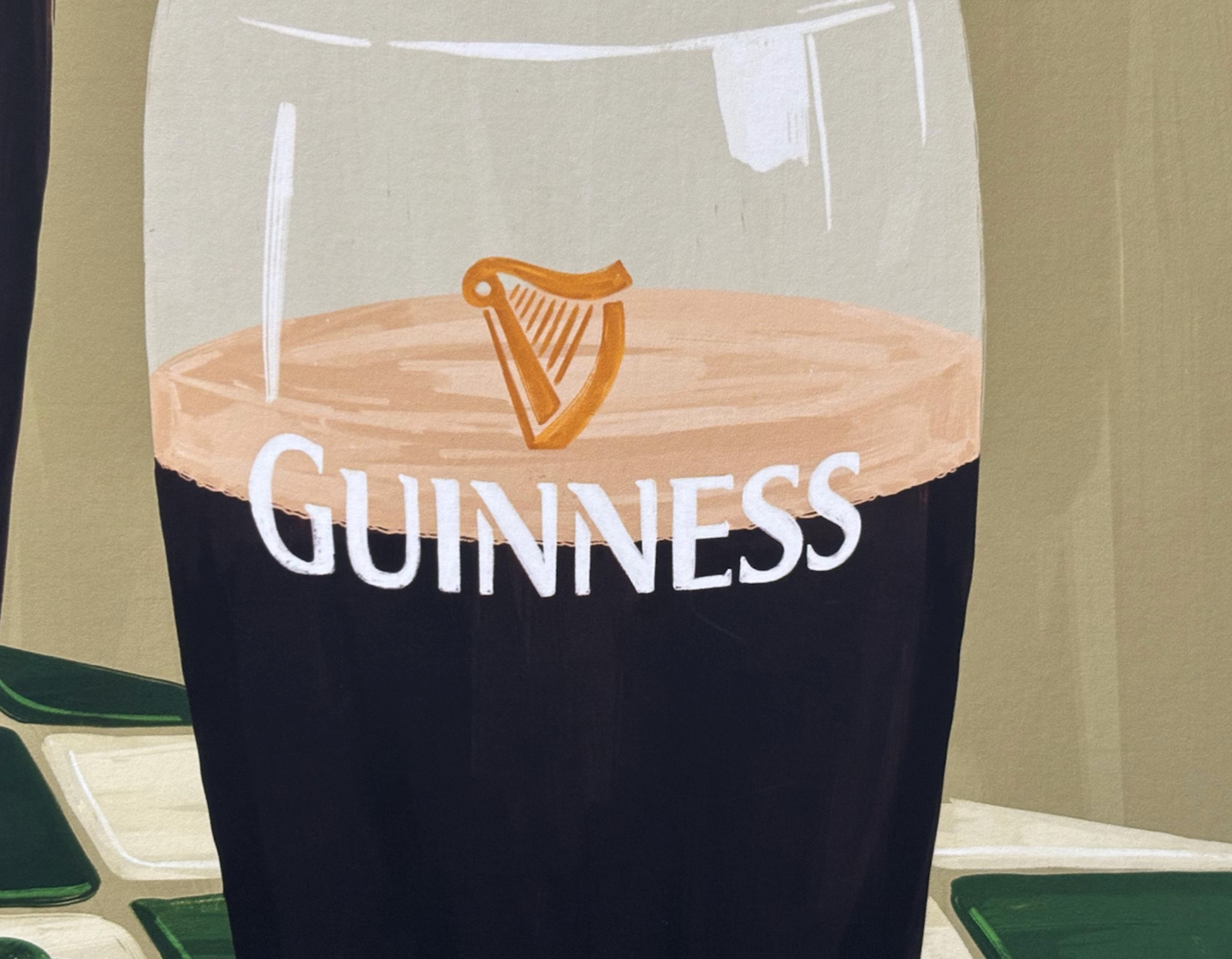
Guinness scored 90, and Heineken 83. They are the only two brands in the study to reach the top tier, and Guinness holds the highest score on the ARA record.
It leads or ties for the lead on four of the five attributes: Recommendation 19, Semantic Clarity 19, External Sentiment 19, Voice 18. Its lowest number is Structural Readiness at 15, which is the tell — Guinness is not winning on infrastructure. Heineken beats it there.
Guinness wins because it is the most specific brand in the category. It has a colour, a ritual, a country, a glass, and a widely-repeated claim about how long the pour should take. When a model is asked for a beer that is iconic, or trusted, or worth taking seriously, that specificity gives it something to hold onto. Ask the same model for a light lager and the specificity does nothing — Guinness scores zero on the crisp-and-sessionable question, and on the barbecue question.
The lesson is not that every brewer should be Guinness. It is that the machines reward brands that are unmistakably one thing, and have very little to say about brands that are broadly acceptable at everything.
KEY FINDING 06
BORROWED PRESENCE, AND LATENT VALUE
ARA holds two forces apart deliberately. When a brand's fundamentals run ahead of its recommendation, we call the gap Swell — latent value the models have not priced in, and the cheapest growth available. When recommendation runs ahead of fundamentals, it is Ebb — borrowed presence that reprices whenever the models next refresh.
Beer is a Swell category. Seven of the eleven brands are carrying more equity than they are converting. The three deepest are Carlsberg, Asahi and Tsingtao — the same brands from the zero finding, which is what a translation failure looks like on the ledger. But the most commercially interesting Swell belongs to Athletic Brewing: fundamentals of 16.5, third-strongest in the study, against a recommendation score of 13. It is the only brand in the cohort that all four models name on the non-alcoholic question — and it converts almost nowhere else. That is a brand one category-adjacent story away from a much larger share of the shelf.
On the other side, Corona and Bud Light are the study's two Ebbs — both recommended roughly six points ahead of what their fundamentals support. Bud Light has the weakest fundamentals in the cohort at 10 out of 20 and the fourth-strongest recommendation score. It is being named on residual familiarity rather than on anything the models currently understand about it, and that is the least durable position in the study.
WHAT THIS MEANS IF YOU ARE A BEER BRAND
Three things, in the order they will cost you money.
Being understood is not the same as being recommended, and in this category the two are barely related. Beer's comprehension scores are the strongest of any attribute and its recommendation scores the weakest. If your AI strategy is a content and structured-data programme, you are funding the attribute the category has already won.
Your competitive set is wider than your benchmark set. A hundred and thirty-four brands outside this cohort were recommended to drinkers, several more often than the global names in it. You are not competing for the shelf against ten peers; you are competing against whoever the model finds most credible for the question.
The moments you are missing are not empty. They are occupied. Nine of this category's recommendation moments are held entirely by brands outside this study — including every model's answer to what a newcomer should drink. That is not open shelf waiting to be claimed; it is shelf already lost to smaller competitors, and winning it back costs more the longer the answer sets.
Two brands in this study were invisible to every model on every question, and neither is a small company. Nothing about that is permanent, and nothing about it fixes itself.
The shelf you are optimising for is no longer the shelf where the decision gets made. Does your brand know itself clearly enough that a machine can understand it?
ARA Beer Q2 2026 · 11 brands · Claude, GPT-4o, Gemini, Perplexity · first-time category study. Recommendation is scored on ARA's current 0–20 scale; the study's original April 2026 scoring used a 0–17 recommendation scale, so most figures here sit two to four points above the archived record — Stella Artois is the exception, a point below it. Position scored on an eleven-question battery; this reading is the baseline for future quarters, so no movement figures are reported. Your brand isn't listed? Request an ARA audit → index.araco.aiindex.araco.ai