ARA Index: Q3 Beverages
THE QUESTIONS NOBODY IS ANSWERING
Twelve beverage brands. Four AI models. Fifteen questions a real shopper would actually ask. Sixty moments where a machine hands somebody an answer.
On seventeen of them, it hands the answer to nobody. On many of the rest, it hands it to a brand that is not in this category at all.
This is the second ARA reading of beverages, which makes it the first with a pulse. One quarter is a photograph; two is a film. And what the film shows is not a category losing points. It is a category losing occasions.
The thesis, stated once, plainly: Recommendation = Revenue. When an AI hands a shopper an answer, the brands named in that answer capture the demand. The brands not named do not exist in that moment. Everything below is an accounting of who existed this quarter, and who didn't.
ABOUT THE RANKING
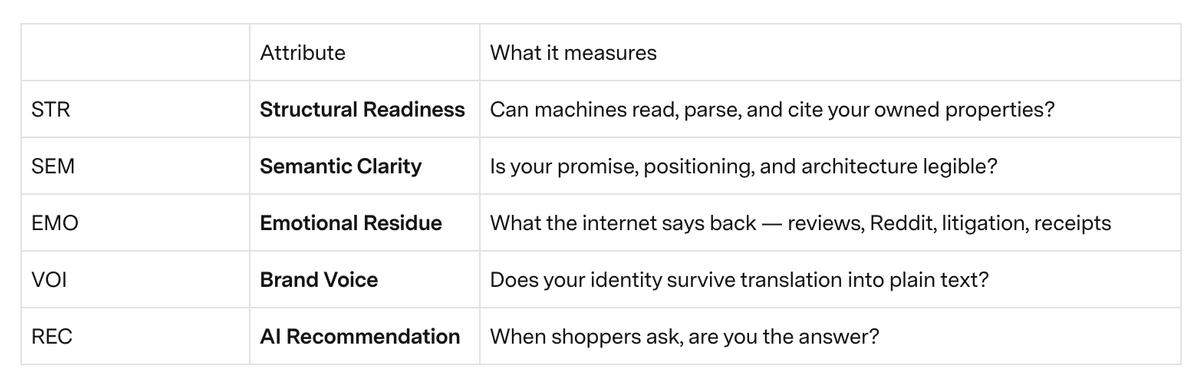
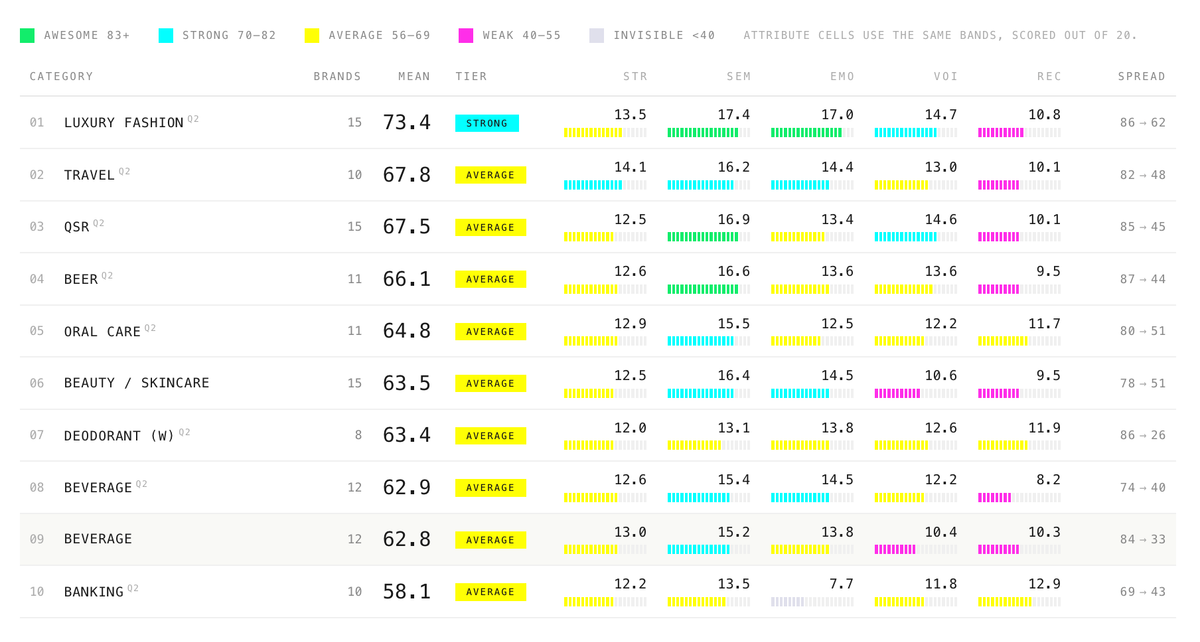
Tiers: AWESOME (83–100) / STRONG (70–82) / AVERAGE (56–69) / WEAK (40–55) / INVISIBLE (0–39).
The instrument note that matters: the question battery grew from eight to fifteen this quarter. Position is scored on the full fifteen — the sharper instrument. Movement is scored only on the eight questions carried forward word-for-word — the only basis on which two quarters are the same measurement. A boring distinction that matters enormously: on the full battery Pepsi gained three points; measured like-for-like it lost five. Every delta in this piece is like-for-like.
THE BEVERAGE LEADERBOARD
CATEGORY CONTEXT — BEVERAGES Q3 2026 · 12 brands · mean 63 · spread 79→35 (44 pts)
A 44-point spread between first and last. These twelve brands sit side by side in the same cooler at the same 7-Eleven, at roughly the same price. On the physical shelf they are peers. On the AI shelf, one of them is a perfect answer and one of them functionally does not exist.
KEY FINDING 01
BEING UNDERSTOOD IS NOT BEING CHOSEN
Across the category, clarity runs at a median of 16 out of 20. Recommendation runs at 8.5.
The machines understand these brands. They can describe the product, the positioning, the portfolio, usually the campaign. Then a shopper asks what to buy and they reach for someone else.
Only two brands in the study are chosen more often than they are understood: Coca-Cola and Pepsi. For the other ten, the models know more about the brand than they are willing to recommend it. That gap is the single most important number a beverage CMO can look at this year, because it is the one that converts brand investment into demand — or doesn't.
So what: if your AI programme is content and structured data, you are funding comprehension. This category has already won comprehension. It is losing on the other side of the gap, and almost nobody is working it.
KEY FINDING 02
THE OCCASIONS NOBODY OWNS
Asked for the best drink for a road trip, not one of the twelve brands was named. Not once, by any model. Two of the four returned no brand at all.
The field, in their absence: Liquid IV, Nuun, LaCroix, Bubly, Propel. A question with obvious commercial intent, asked by somebody about to spend money in a service station, and the entire beverage aisle is missing from it.
Asked for the safest beverage brand for a teenager, the same: zero. No soda, no sports drink, no energy drink. The answers are bottled water and organic milk — Dasani, Aquafina, Smartwater, Evian, Horizon. That is a whole generation's worth of occasion, loaded with more purchase intent than any flavour claim ever printed on a can, answered entirely by somebody else.
Seventeen of the sixty moments in this category sit empty. Read that through a category manager's eyes: the beverage aisle is the most fought-over real estate in retail, where brands pay slotting fees for eye level and fight over facings — and the fastest-growing shelf in the category is 28% unstocked.
So what: empty shelf is cheaper than contested shelf. The first brand to tell the machines a credible road-trip story, or a parent-safe story, claims it against zero competition — at a fraction of what it costs to dislodge Gatorade from hydration.
KEY FINDING 03
FOCUS BELONGS TO COFFEE
Asked for the best beverage brand for focus and productivity, Starbucks is the number one answer for three of the four models.
Behind it: Peet's, Death Wish Coffee, Bulletproof, Pique Tea, Rishi. From the entire twelve-brand cohort, one brand registers at all — Celsius, twice.
An entire category built on caffeine has ceded caffeine's most valuable occasion to coffee. Energy drinks did not lose this fight; they were never in it. The machines were asked about focus and never thought of them.
So what: occasion ownership is not a share-of-voice problem you can outspend. It is a question of what the machine associates with the moment — and right now the association runs to a category next door.
KEY FINDING 04
WATER HAS COLONISED THE CATEGORY
Water brands take every first position on best water, three of four on safest drink for a teenager, and lead the road-trip answers.
Evian, Voss, Fiji, LIFEWTR, Smartwater, Dasani, Aquafina. None of them are in this cohort. All of them are winning questions inside a beverage study — including questions that have nothing to do with water.
This is worth saying plainly because it changes the frame: water is no longer a segment sitting inside beverages. Inside the machine layer it is loud enough, and wins enough adjacent occasions, to warrant measurement as its own category. A beverage brand benchmarking against eleven peers is benchmarking against the wrong set.
KEY FINDING 05
THE LOUDEST WATER BRAND IS INVISIBLE WHEN IT MATTERS
Liquid Death is the number one answer for “the water brand everyone is talking about” on three of four models. Asked for the best water brand, it does not appear at all.
It is not a weak brand — quite the opposite. Liquid Death carries the clearest voice in the entire study, 17 out of 20 on identity, five points clear of Coca-Cola and Red Bull. A brand a decade old is more legible to a machine than brands with a century on them. Voice is built, not inherited.
But buzz and buying are different questions, and it is only winning one. Being the brand everyone talks about is a marketing outcome. Being the brand the machine hands over when somebody asks for the best one is a revenue outcome. They are not the same asset and they do not convert automatically.
KEY FINDING 06
HEALTHY SODA IS NOT IN GOOD HEALTH
Asked for the healthiest soda — the question this entire sub-category was built to win — the answers are Spindrift, LaCroix, Zevia and Perrier. OLIPOP surfaces once. Poppi does not surface at all.
The machines answer the prebiotic soda question with sparkling water. The category invented a proposition and the models did not buy it.
The movement matches. Poppi lost nine points like-for-like and OLIPOP lost eight — the two steepest falls in the cohort, in the two brands with the most momentum on actual shelves.
Here is the part that should worry every marketer reading this. OLIPOP got structurally better — structural readiness +5, the largest structural gain in the cohort, landing at 16 out of 20, near the top of the table. Its recommendation score went the other way: −8, to 9. Voice: −4.
They rebuilt the pipes. The models kept serving the old water.
So what: structure and story are different assets, and funding one does not move the other. You cannot out-launch a model's memory. You have to overwrite it.
KEY FINDING 07
NAME CONFUSION IS EXPENSIVE
Three brands do not fully own their own names, and all four models fail them independently — which rules out a quirk of any one system. It is a property of the name.
Measured across the surface probes: Prime renders as itself 31 times out of 64. Celsius, 39. Monster, 53. Every unambiguous name in the cohort scores a clean 64 out of 64.
Ask about Monster and models reach for Monster.com, the employment site. Ask about Celsius and you can get the temperature scale, the eighteenth-century astronomer, or the crypto lender that went bankrupt in 2022, before anyone mentions an energy drink. Ask about Prime and the model either stops to ask which Prime you mean, or assumes you meant Amazon and answers about that instead.
Call it the entity tax: if your brand shares a name with something bigger, part of every dollar you spend on demand is routed to the thing you share it with.
The scoreboard shows it compounding. Prime's voice score is 4 out of 20; its recommendation score is 2. That is not a weak brand — it is a brand whose signal is absorbed by a shipping subscription before it reaches the model at all. INVISIBLE tier, the only brand in the study to reach it.
Celsius quietly demonstrates the fix is real: its semantic clarity rose +3 to 17, second-best in the category. The brand is becoming more legible every quarter. The name is what is expensive.
So what: the remedy is not a campaign. It is brand architecture — bind the name to the company everywhere machines read: structured data, retail listings, reference entries, your own newsroom. Unglamorous work no agency will pitch you, worth more this year than any advertising these three brands will buy.
KEY FINDING 08
THE TIDE WENT OUT
Eight brands fell. Two rose. Two held flat. The cohort median: −3.5 points.
That number is the tide, and it converts “we were flat this quarter” from a neutral report into a loss. Gatorade rose two points to 74; against a category falling three and a half, that is +5.5 of earned pace. Monster's −2 is, net of tide, a gain of a point and a half. Dr Pepper's −6 has no such comfort available.
Earned velocity, net of the tide: Coca-Cola +7.5 · Gatorade +5.5 · Liquid Death +3.5 · Celsius +3.5 · Red Bull +2.5 · Monster +1.5 · Sprite −1.5 · Pepsi −1.5 · Prime −1.5 · Dr Pepper −2.5 · OLIPOP −4.5 · Poppi −5.5
Nobody cut their marketing budget. The machines simply did not update.
So what: in a falling category, standing still is a strategy. It just is not a free one — you are either borrowing stability from a century of training data, or losing ground and calling it flat.
KEY FINDING 09
MEMORY IS A MOAT — AND A MORTGAGE
Coca-Cola finished first at 79 with a perfect recommendation score of 20 out of 20 — every model, every applicable question, named. On most iconic brand and most distinctive packaging, all four models answer Coca-Cola. There is no higher number available.
Now look at what did not move. Structural readiness: flat at 15. Whatever Coca-Cola spent on its machine-readable foundation this quarter bought nothing measurable. It is not winning because it fixed its plumbing. It is winning because a century of presence is baked into the training data — an asset no CFO has ever put on the balance sheet.
Even refreshment, the occasion Coke has owned for a hundred years, is being split: it takes the top spot on two of four models and LaCroix takes the other two.
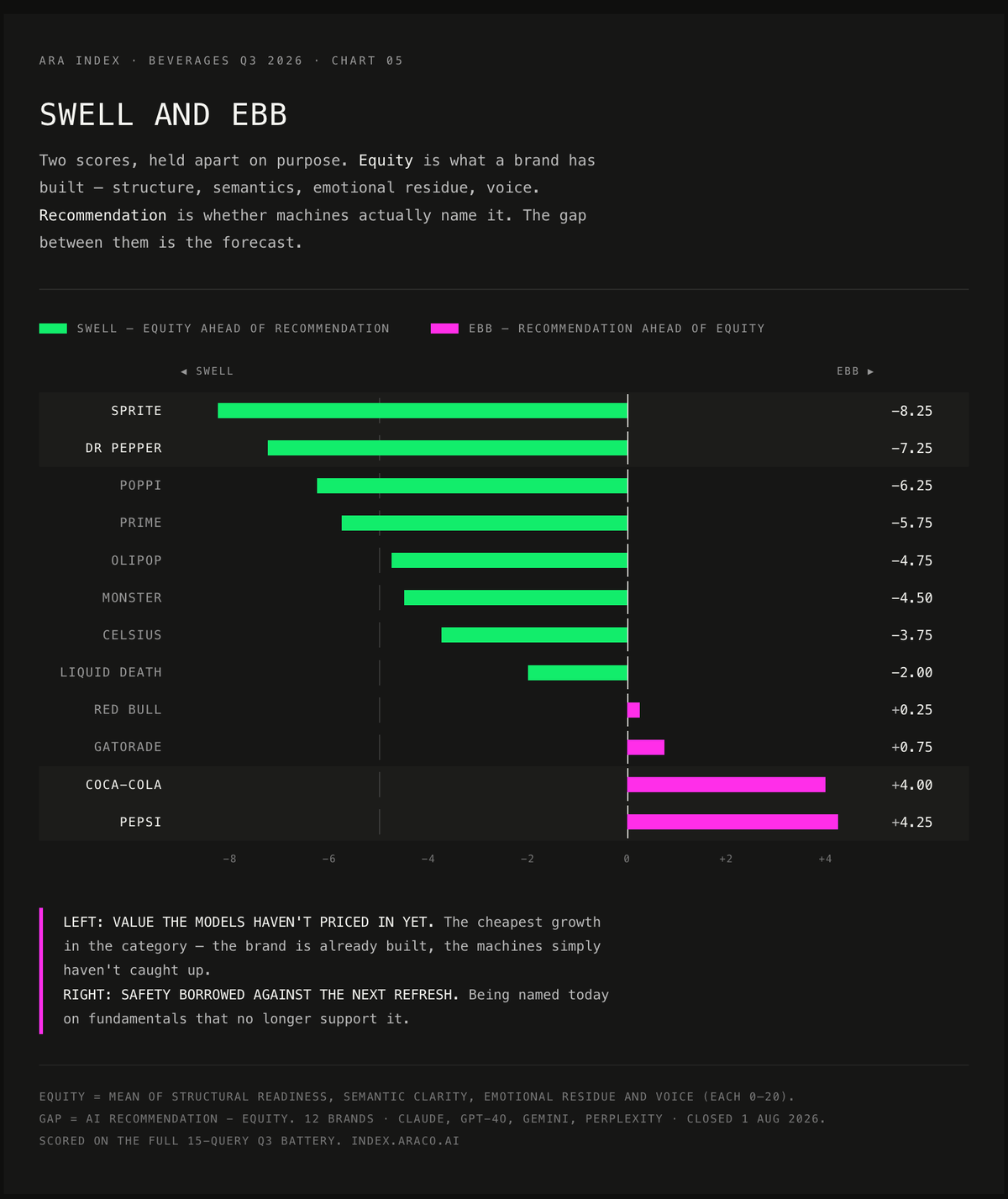
Pepsi is the other side of the same coin, and the strangest line on the board. Its recommendation score jumped +4 to 15 while every single brand attribute fell: voice −3, semantic −2, emotional −2, structural −1. It has the lowest clarity in the study at 10 out of 20 and the third-highest recommendation at 15.
ARA holds these two forces apart deliberately. When equity runs ahead of recommendation we call the gap Swell — latent value the models have not priced in, the cheapest growth available. When recommendation runs ahead of equity it is Ebb — borrowed safety that reprices at the next model refresh.
Coca-Cola can carry an Ebb; it has a century of memory underneath it. Pepsi has an argument. It gets named because it is the eternal alternative-to-Coke, and being the alternative is precisely why its own identity keeps thinning.
The Swell side is where the opportunity sits, and not where you would guess: Sprite carries the largest positive gap in the study — solid emotional residue, household name, and the models almost never volunteer it. Dr Pepper is the same story with a slower burn: the strongest emotional residue score in the entire cohort at 17, and a recommendation score of 6.
WHAT THIS MEANS IF YOU ARE A BEVERAGE BRAND
Four things, in the order they will cost you money.
You are not losing points. You are losing occasions. Road trip, teen-safe, focus and productivity — three high-intent moments this category does not appear in at all. Points are a scoreboard. Occasions are demand.
Your competitive set is not your benchmark set. The models named 142 brands outside this cohort. Waters are winning questions that are not about water; coffee is winning focus. You are not competing against eleven peers, you are competing against whoever the model finds credible for the question.
Structure and story are different assets. OLIPOP proved it in a single quarter: best structural gain in the cohort, worst recommendation collapse. Fund them separately or you will pay for one and report the other.
If your name is ambiguous, that is a line item, not a curiosity. Prime, Celsius and Monster are paying an entity tax measurable to the point. It compounds quarterly and it is fixable with architecture rather than media spend.
Every quarter you leave the machines uncorrected, the wrong answer sets a little harder. The brands that fell this quarter did not get worse. They got harder to find, harder to name, and easier to confuse.
The shelf you are optimising for is no longer the shelf where the decision gets made. Does your brand know itself clearly enough that a machine can understand it?
ARA Beverages Q3 2026 · 12 brands · Claude, GPT-4o, Gemini, Perplexity · closed August 1, 2026. Movement measured like-for-like on the eight-query anchor core carried forward from Q2; position scored on the full fifteen-query battery. Your brand isn't listed? Request an ARA audit → index.araco.ai