Artificial Twin: Part Two
Part Two: Whiteboarding the artificial twin
Issue #003. Sketching the architecture.
In Part One I made the case that every brand has an artificial twin. It wasn't asked for. It certainly wasn't briefed and intentionally crafted and optimized. It is highly likely the people responsible for the brands didn't even realize what was happening.
This artificial twin version of the brand is built as a marked-down version of you. It's still very young, but it is growing up quickly and getting bigger and stronger every minute.
This issue is the architecture.
The framework
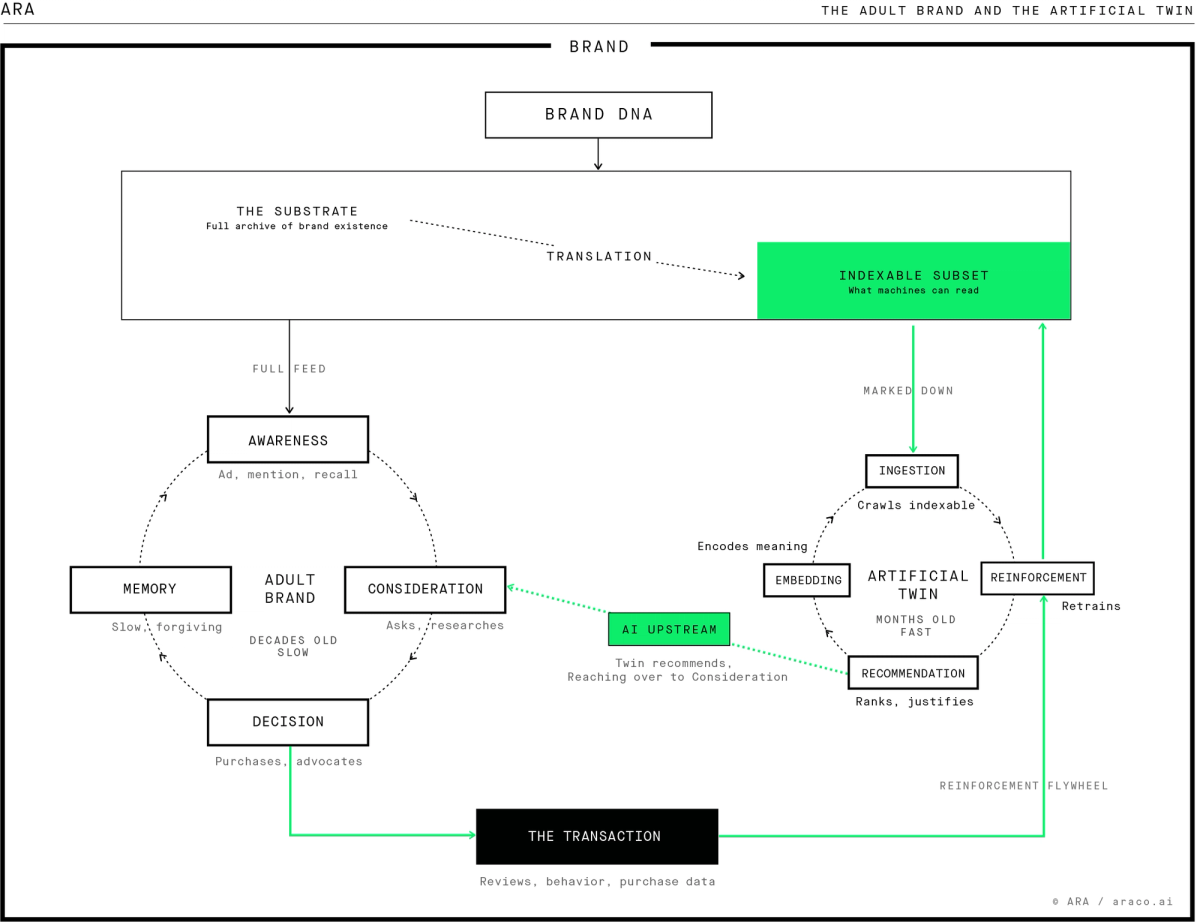
Brand DNA at the top — value, purpose, strategy, identity, governance. The brand at its source.
The DNA emits into the Substrate. This is the full archive of brand existence across time and space. The substrate is everything your brand is, has done, and has been accused of.
Below the substrate, two coupled loops descend. On the left, the Adult Brand — the version humans live with. On the right, the Artificial Twin (AT) — the version machines render.
A cross-arrow shows the AI is now upstream of human consideration.
A reinforcement flywheel closes the loop, sending transaction data back into the indexable layer to retrain the twin.
All of it sits inside one boundary labeled Brand.
That's it. That's the whole sketch. Let's unpack and push on it. What holds up and what breaks. Better to break stuff early and often.
Brand DNA
The core. The source code for the brand. Value, purpose, strategy, identity, governance — the choices made in the boardroom and lived in the operations.
Everything downstream executes and translates it.
Most brand frameworks stop at brand and audience. This one starts at brand DNA and follows the signal further.
The Substrate
One substrate. The full archive of brand existence. Sensory. Cultural. Ritual. Spatial. Behavioral. Structural.
Humans live the full thing directly, through bodies and time. Machines read what they can crawl. Same source, different experience.
The substrate looks different in every category.
For a CPG brand, the substrate is the can in your hand, the shelf placement, the cooler at the bodega, the Super Bowl spot, the influencer unboxing, the Reddit thread comparing your fiber content to your competitor's, the Amazon reviews, the FDA correspondence, the trade show floor, the way your sales rep pitches a buyer at Kroger. It's the recipe, the manufacturing process, the lawsuit, the recall.
For a financial services brand, the substrate is the branch experience, the tone of the customer service rep, the regulatory filings, the analyst reports, the CEO's testimony to Congress, the marble in the lobby, the typeface on the credit card, the Bloomberg interview, the data breach disclosure, the Reddit thread about your APR, the rates buried on page 47 of a prospectus.
For an experience brand like Disney, the substrate is the theme park ride, the smell of popcorn in Main Street USA, the cast member's eye contact, the queue design, the merchandise, the streaming UI, the Marvel acquisition, the lawsuit with Florida, the parent's vacation memory, the kid's birthday cake, the box office numbers, the strike, the executive shakeup.
For a luxury travel brand, the substrate is the doorman's posture, the thread count, the soft close on a wardrobe door, the restaurant reservation that's somehow already made for you, the unboxing of an amenity kit at 35,000 feet, the Conde Nast list placement, the Tripadvisor one-star, the staff turnover, the renovation, the price point, the discretion.
Each of these substrates is enormous. Most of it is sensory, cultural, ritual, spatial, behavioral. A small slice is structural — already organized in ways machines can read.
The artificial twin is built from that slice.
The Markdown
Between the full substrate and what machines can actually read is a gap. The things that can't be transcribed, indexed, or embedded.
The haptics. The pour. The in-store ritual. The sonic logo. The smell of a freshly opened box. The feel of leadership conduct.
The markdown is the cost of compression. What gets dropped on the way through. Most brands don't know how much is being lost.
The markdown is where most brands die.
Olipop and Poppi
Olipop and Poppi are the two challenger brands defining the prebiotic soda category.
To a human walking down the cooler aisle, they look similar. Great colors, same packaging format, delicious flavors, gut health claims, similar shelf placement. The Adult Brand loop forgives the ambiguity. Plenty of consumers couldn't tell you which is which.
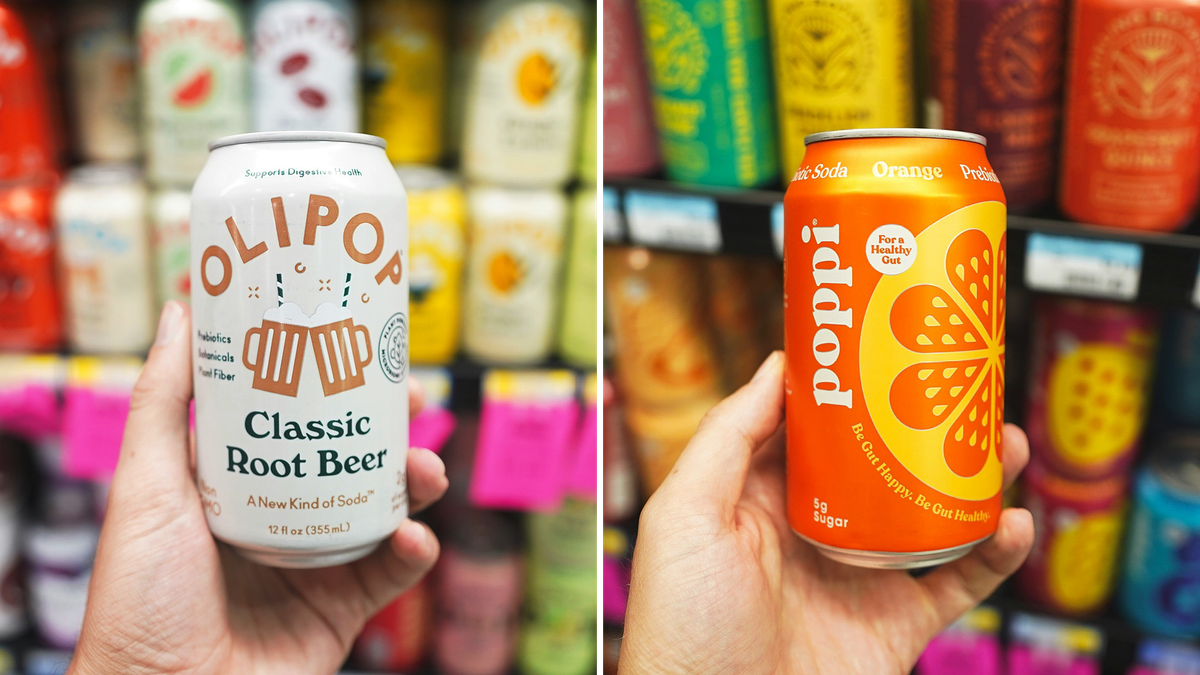
The artificial twin sees something different.
Olipop has 9 grams of fiber per can. Real prebiotics. Substantiated claims. The substrate carries that truth into the indexable layer cleanly — product pages, press, third-party reviews all align with the underlying product.
Poppi has 2 grams. The brand was sued in 2024 over its prebiotic claims. The substrate tells a more contested story.
Ask an AI which prebiotic soda actually delivers on its promises and it doesn't flip a coin. It reads the structural signal. Olipop wins that recommendation cleanly. Not because it markets harder. Because its substrate is more coherent, and what's true in the product survives the markdown.
The artificial twin can be more discerning than the lived brand.
Machines don't tolerate ambiguity the way humans do.
The Adult Brand Loop
The human loop is slow, sometimes a lifetime. Four stages cycling clockwise: Awareness → Memory → Consideration → Decision.
Decades of body memory. Forgiving of inconsistency. Compounds slowly. The brand humans actually have a relationship with.
This is the loop brand strategy was built for. The Adult Brand isn't dying. It's sharing the room now.
The Artificial Twin's Cycle
The machine loop is fast but shallow, with the twin sitting at the center as the artifact the cycle exists to maintain. Four operations rotating around it: Ingestion, Embedding, Recommendation, Reinforcement.
The twin is months old. The cycle forms and reforms it fast. Whatever the twin learned in its first six months, it carries forward until it is retrained.
The twin isn't a stage in the cycle. It's the output of the cycle.
AI is upstream
The AI cycle isn't parallel to the human loop and doesn't follow a typical customer journey or funnel. The AI is upstream of the human now. The recommendation step feeds directly into human Consideration. By the time we are considering options, the artificial twin has already made us a shortlist.
It isn't parallel. It's pre-filtering.
If you're not yet seeing AI as upstream of consideration in your category, watch your search referral data over the next quarter. It's already happening. And like the AT, it's only growing faster and stronger.
The Reinforcement Flywheel
The system closes on itself.
Transactions produce reviews, behavioral signals, purchase data, word of mouth and even love or frustration. All of that flows back into the indexable layer. Which retrains the twin. Which produces a slightly different version of you next cycle.
The flywheel runs whether you participate or not. Coherent brands compound. Incoherent ones drift further from themselves every cycle.
There's no neutral state.
Olipop is the flywheel working in someone's favor. Every honest review reinforces the truth in the substrate. Every AI recommendation drives more sales. Every sale generates more reviews. The twin gets sharper.
Poppi has the same flywheel. Running in a less helpful direction.
How AI Brand Intelligence and GEO fit together
A few people have asked whether this is GEO — Generative Engine Optimization. It's adjacent.
GEO is the practice of making content discoverable, extractable, and citable by AI systems. Schema, structured data, on-page copy, multi-platform presence on Reddit and YouTube, earned mentions, technical accessibility. Real work. Necessary work.
GEO and AI Brand Intelligence are complementary.
There are three altitudes in the AI brand era.
Strategy — what the brand actually is, does, and stands for. Product. Experience. Ritual. Behavior. Leadership. The choices that produce signal in the world.
Intelligence — measurement of how those strategic choices are showing up in the substrate. How coherent the brand reads to AI. Where the markdown is hurting most. The diagnostic layer.
Execution — the work of optimizing how existing signal performs. GEO operates here.
Each altitude does a different kind of work on the same field. Strategy shapes the substrate. Intelligence measures it. Execution optimizes it. A brand operating well in the AI era is doing all three.
There is a precedent.
In the early 2000s, SEO fragmented into thousands of agencies and tools. Tactical work performed at scale, across every brand on the internet. At the same time, a separate category emerged for measuring digital competency at the brand level. L2, a brand intelligence company founded by Scott Galloway, built the Digital IQ Index. This was a strategic diagnostic that scored a brand's overall digital posture, benchmarked across competitive sets, used to make portfolio-level decisions about where to invest.
The two layers existed in parallel and supported each other. SEO worked on rankings and traffic. Digital IQ measured whether the digital portfolio as a whole was producing strategic outcomes. Brands used both. They answered different questions.
The same pattern is taking shape now. GEO works on how content performs in AI systems. AI Brand Intelligence measures how the brand as a whole is showing up. Different work. Same goal.
Next
Next: Part Three. The Now What. What to actually do with the architecture once you accept it.
Footnotes
More thoughts on GEO…
GEO operates on digital content about the brand.
Take a trade show booth. The booth exists physically — sensory, spatial, ritual. Someone experiences it: a buyer, a sales rep, a journalist on assignment. Someone then creates a digital artifact about it — a tweet, a blog post, a YouTube clip, a trade publication write-up. GEO operates on that digital artifact, making it discoverable, citable, and extractable by AI systems.
The booth itself is upstream of GEO. So is the experience of it. So is the act of translating that experience into digital form. GEO's lever is the digital artifact at the end of the chain.
The same chain applies to every dimension of brand expression that exists before it's digitized — the in-store ritual, the doorman's posture, the sales pitch on the floor, the sensory moment at the point of purchase. AI Brand Intelligence measures the fidelity of the Artificial Twin against the brand's stated positioning, its substantiated claims, and its market performance — assessing where the Twin's rendering holds together and where it drifts.
The L2 / Digital IQ inspiration
L2 (now Gartner) was a brand intelligence think tank and membership organization founded by Scott Galloway at NYU in 2010. Its flagship benchmark, the Digital IQ Index, scored brands against peers on more than 350 quantitative and qualitative data points across categories ranging from luxury to consumer packaged goods to pharmaceuticals — diagnosing digital strengths and weaknesses. The Index sat inside a broader stack that included executive forums, clinics, advisory services, and a research engine. Brands paid for membership. Categories were ranked. Strategic decisions were informed by the score, not made by it. L2 was acquired by Gartner in 2017.