The Swell and the Ebb
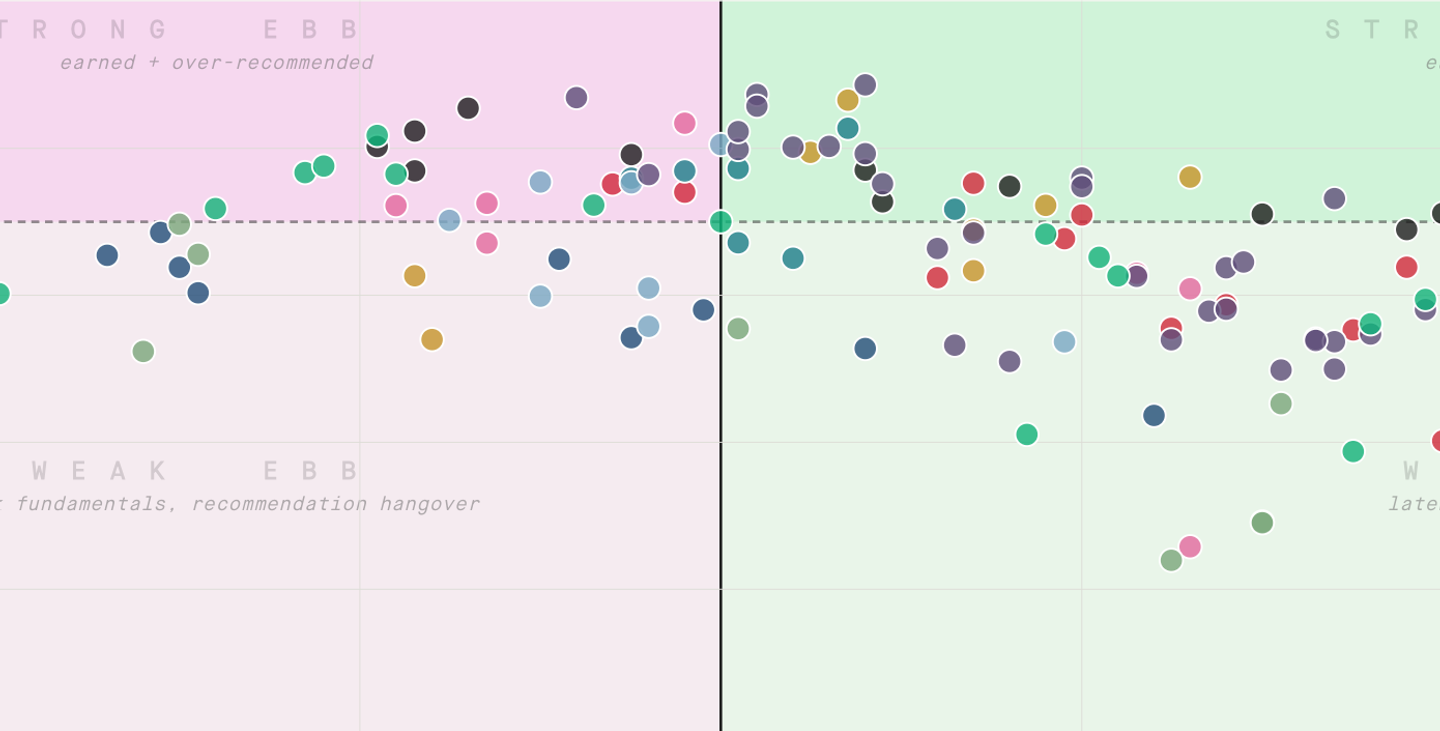
This chart shows the distance between two things for each brand studied. Brand equity (A1+A2+A4+A5) and Brand recommendation (A3). The vertical axis is the overall ARA score, and the x-axis is the difference in equity and recommendation. Essentially, how much is your current state pulling equity from your future.
Two scores, not one
Across every audit we hold two measurements apart. The first is fundamentals: how legible, how clear, how emotionally resonant, how distinct a brand is when a model reconstructs it from scratch. The second is recommendation: how often the model actually names the brand when a real buyer asks for the best option in its category. Add them together and you get a tidy league table. Pull them apart and you find out which brands are coasting and which are quietly underpriced.
We call the distance the gap. When fundamentals run ahead of recommendation, that is a Swell — earned equity the machine has not yet surfaced. When recommendation runs ahead of fundamentals, that is an Ebb — a brand the machine is still recommending at a level its current reality no longer supports.
The Swell
A Swell is the good kind of gap. The brand is stronger than the machine currently lets on. The reasons to recommend it already exist — they are simply not yet structured in a form the model reaches for. This is latent equity, and it is the cheapest growth a brand can buy, because the hard work is already done. What is missing is the publishing that converts earned strength into machine-legible recommendation. The brands built on cultural energy the models have not caught up to — modern beverages, challenger labels, the most-followed teams — live here.
The Ebb
An Ebb is the warning. The machine recommends the brand more than its fundamentals justify — coasting on a name that used to mean more, on training data that has not noticed the brand thinned out underneath. Ebb brands feel safe, because the recommendation is still flowing. It is the most expensive kind of safety, because it is the kind that reprices without warning when the next model refresh catches up to reality.
137 brands, one picture
Here is every brand we have audited — ten categories, 137 brands — on a single axis. Each dot is a brand. Position left to right is the gap. Colour is the category. Hover any dot for its numbers, click a category to isolate it, type to find a brand.
The pattern is not random. Categories built on cultural energy — sports franchises, modern beverages, luxury — sit deep in the Swell: the machines under-recommend them relative to the equity they carry. Categories built on legacy trust — banking above all — sit in the Ebb: the machines recommend them out of a habit the fundamentals no longer fully earn. The Swell and the Ebb are not brand stories. They are category weather.
The one rule that keeps it honest
A gap only means something when the question matches the brand. Ask a model for the best English Premier League club and it will, correctly, not recommend a Welsh club playing in the Championship — however famous that club has lately become. That is not under-recommendation; it is the machine being precise about category. A Swell is real equity waiting to be surfaced only when the brand actually competes for the question being asked. Read the gap without checking the question, and you will mistake a category mismatch for buried treasure.
What to do with the gap
If you are sitting on a Swell, the move is to publish the structured, machine-readable reasons the model should already be recommending you — before a competitor closes the gap for their own brand. If you are sitting on an Ebb, the recommendation you are enjoying is borrowed, and the loan comes due at the next refresh; the move is to rebuild the fundamentals underneath it while the machine is still generous. And if you are an investor, the gap is a diligence instrument: it tells you whether you are buying earned equity the market has not yet priced, or a recommendation habit that is about to fade.
Strip the recommendation out, rank on fundamentals, and a different league table appears. The brands that should worry are not always the ones at the bottom. They are the ones whose score depends on a recommendation the machine is about to reconsider.